
Persistent Memory Patterns for AI Agents
How Ghost uses a visual knowledge graph and wikilinks to break the zero-memory loop and compound context over time.
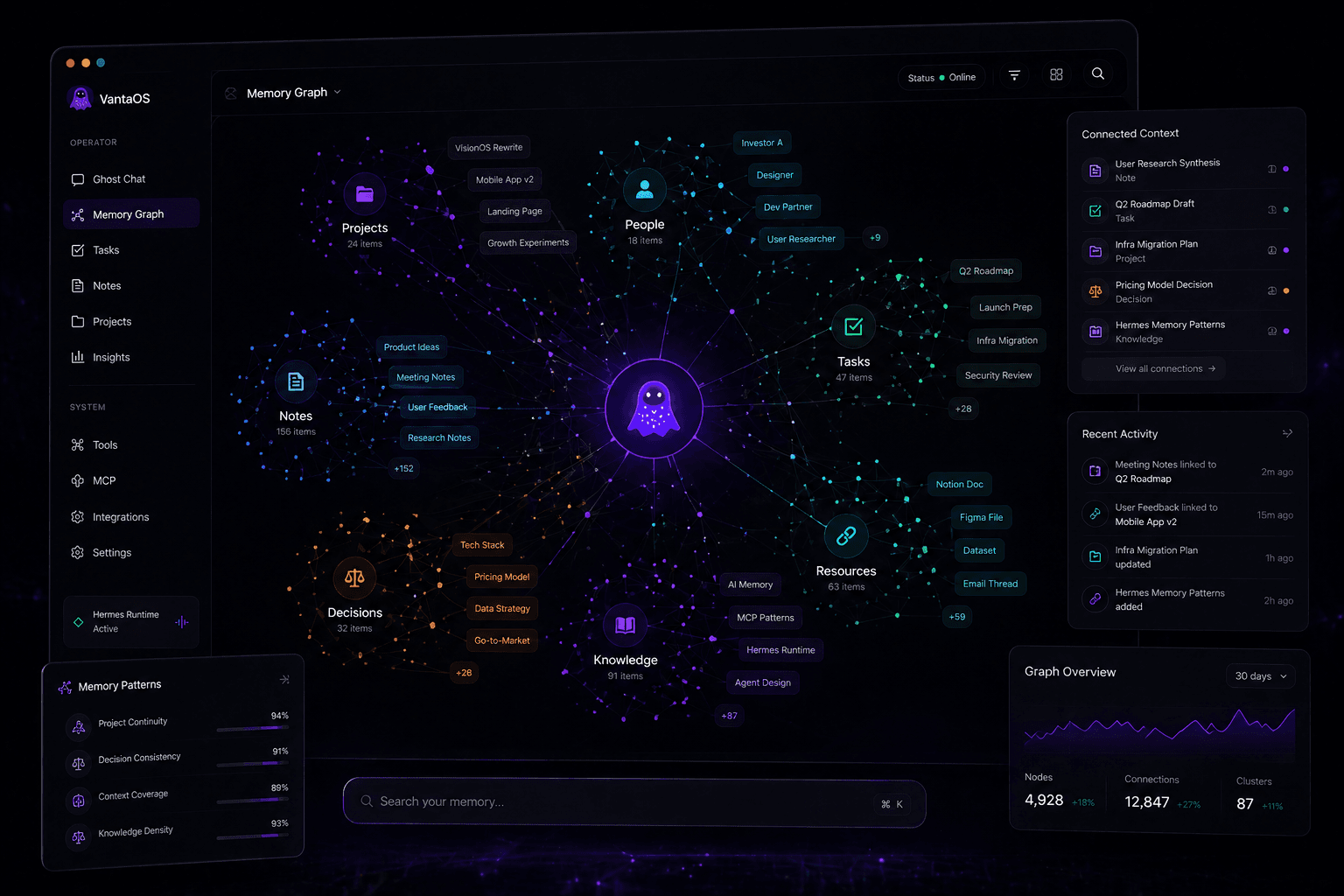
The zero-memory loop
Most AI workflows still behave like a brilliant contractor with amnesia. You brief the stack, the customer, the strategy, and the current blockers. A week later, the same system needs the same briefing again.
Longer context windows help during one session, but they do not automatically create durable product memory. Once a project crosses days, teams, and tools, the problem becomes retrieval and structure rather than raw token count.
Memory should be linked, not appended
Ghost treats memory as a graph of projects, decisions, people, tasks, and open loops. A new fact is not just another line in a transcript; it becomes a connected object the operator can retrieve when the surrounding work returns.
That is why VantaOS leans into Markdown and wikilinks. They keep the memory portable and inspectable, while giving the agent a practical map of what belongs together.
- Projects connect to active tasks and decisions.
- People connect to meetings, deals, and follow-ups.
- Research connects to product bets and launch material.
The operator outcome
The practical goal is simple: the next session should start warmer than the last one. When Ghost helps with a launch, a PR, or a customer reply, it should already know the relevant project context and the prior decision trail.
A memory graph does not replace reasoning. It gives reasoning better inputs.