
How to Build a Founder OS Around Persistent Memory
A practical model for turning scattered founder work into an operating system that remembers decisions.
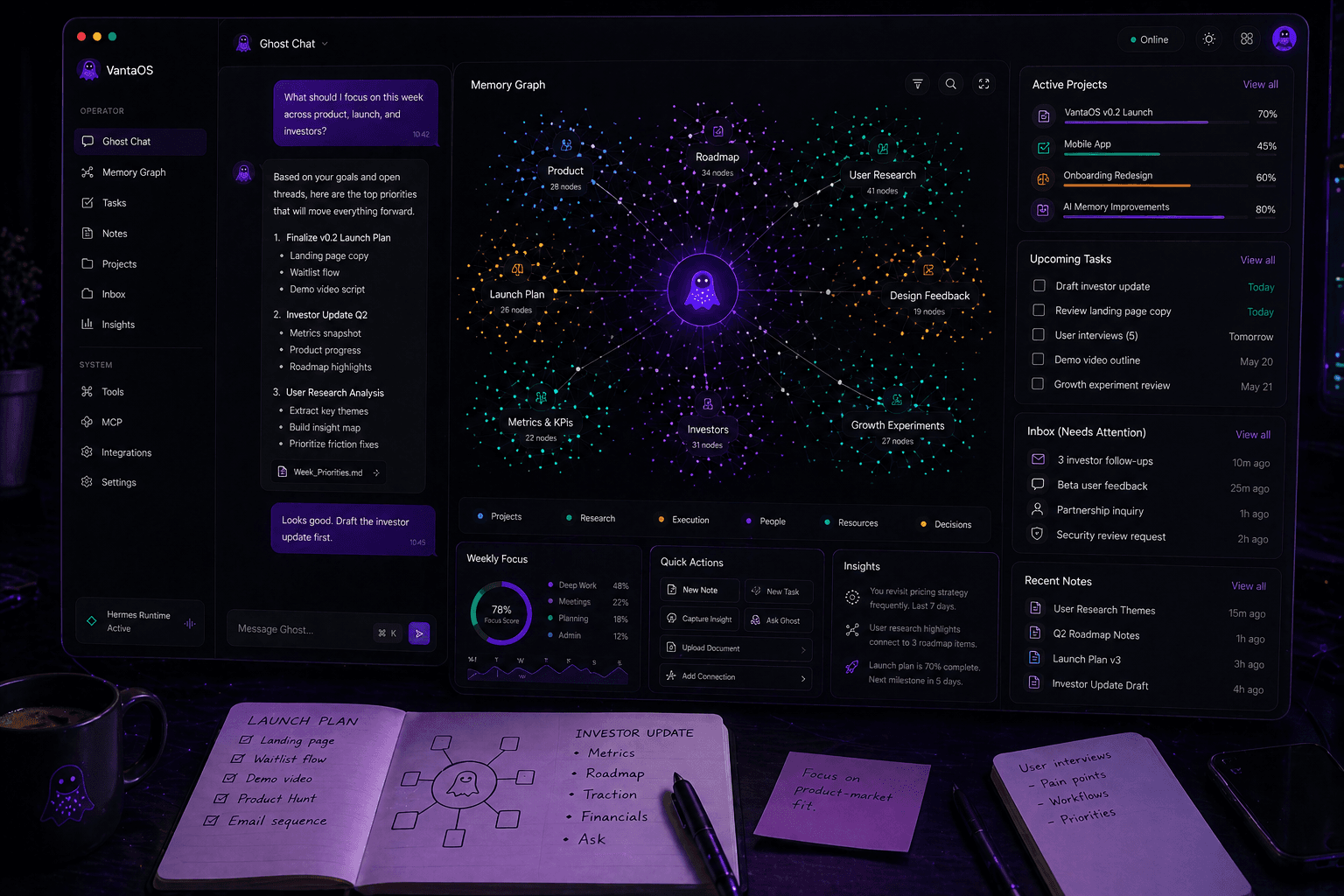
Founders do not lack tools
The average founder stack already has email, Slack, Notion, GitHub, Linear, a calendar, a CRM, and three AI tabs. The problem is not tool count. The problem is that context does not compound across them.
A Founder OS should start with memory, not dashboards. Dashboards show state. Memory explains why that state exists.
The three layers
The first layer is capture: meetings, decisions, briefs, customer facts, and tasks. The second layer is structure: projects, people, goals, and open loops linked together. The third layer is action: an operator that can draft, route, summarize, and remind from that structured context.
- Capture without structure becomes a pile.
- Structure without action becomes a wiki nobody opens.
- Action without memory becomes automation that forgets.
Where Ghost fits
Ghost is designed as the action layer that can see the memory layer. The product should feel less like a blank chat and more like a teammate who has read the project room before speaking.